

Navigating Distance and Closeness
In early 2020, Niki made a series of wonky and voluptuous clay ‘vases’ that had ladder-like grooves running up and down the sides. Though not intended to be musical instruments, their crispy, lumpy and textured surfaces, as well as their cavernous inside spaces, made them tantalising invitations to touch and draw sound from.
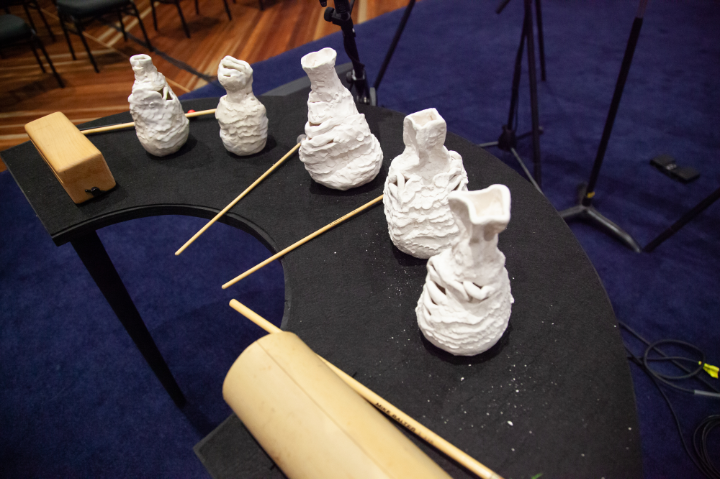
To see and play stems from these online, click here.
In a process of experimenting with rattan mallet handles, and glass and plastic glockenspiel and xylophone mallets, Niki discovered the unique microtonal pitches and delicate and brittle timbres within each object and across the set. Playing gestures such as scraping and tapping led to tinkling, and surprisingly resonant sounds.
Thinking that perhaps there was something interesting here, Niki approached colleague and percussionist friend Hamish Upton, asking if he thought there was some musical merit in these new objects. From here, the two percussionists set about scheming a musical and performative work with new instruments made only from natural materials. Hamish was particularly interested in the ‘ladder’ element of the ceramics which created a guiro-like effect when scraped. Guiros, for context, are instruments with a serrated surface originally made from a gourd that creates a rasping sound when scraped, and are traditionally used in Latin American music. Combining the guiro with the ceramic ladder idea, Hamish set about sourcing different lengths of bamboo and carving grooves into them. As Hamish experimented with the sounds of his bamboo guiros, he found he had successfully created a rasp-able instrument, with a new and distinctly bamboo resonant timbre. This timbre had a long decay and a series of low fundamental pitches, combined with higher partials in the moment of scrape.
With the slowly growing collection of bamboo and ceramic instruments, the two percussionists set about creating a work for the Speak Percussion Bespoke Artist program of which the artists were a part of.
Navigating Distance & Closeness took these instruments and created a musical composition and public performance featuring exclusively the sounds of the new instruments. In a process of developing the musical composition, the artists considered the key themes shaping their collaboration.
Distance and Closeness
The major factor affecting this early stage of the work development, was that each artist was based in a different city, (Niki in Sydney and Hamish in Melbourne) so the artists communicated via zoom, calls and emails in a process of creating their part of the work across a great distance. They set out to find the commonalities and contrasts in the texture, sound, and playability of their respective instruments, sending each other sound clips and videos of prototype sounds and compositional ideas. It was this process of collaborating that led the artists to explore closeness and distance as key themes of the work. In considering the ways this theme could be both in the musical composition and the physical performance, the artists explored a potential presentation model involving multiple percussion setups, some far away from each other, and some right next to each other. Here, during performance, the artists would at times be on opposite sides of the room trying to hear and be heard across a vast distance, and at other times, side by side sharing the same instrument. With this compositional idea in mind, the artist set about designing the installation element of presenting the work.
Installation
Experimenting with how to present the bamboo and ceramics, the artists explored suspending the bamboo for maximum resonance, and placing the ceramics on a sturdy table to minimise their chance of falling and breaking.
As the artists wanted the work to highlight the new sculptural instruments, they decided to steer away from using conventional percussion infrastructure - in this way, drawing attention to the visual design of the new instruments in an almost sculptural context. As such, they designed a table for the ceramics (affectionately termed the ‘macaroni’ table as its shape enveloped the player standing inside) and a tripod setup that suspended the bamboo. Both setups supported the instruments in a unique playing position, inviting new ways to perform on the instruments in space across stacked horizontal planes and semi-circular layouts.
Hamish set out to make this new infrastructure using his friends’ skills in woodwork, with a black spray painted finish on each object.
Exploring the idea of multiple setups spread throughout the room, the artists explored a shared set up in the centre, with two identical / mirrored set ups facing each other. Each set up was to be inhabited at a different point within the composition, and each had a combination of ceramic and bamboo pieces.
Here, the artists found themselves with a percussion installation involving new ceramic and bamboo instruments.